
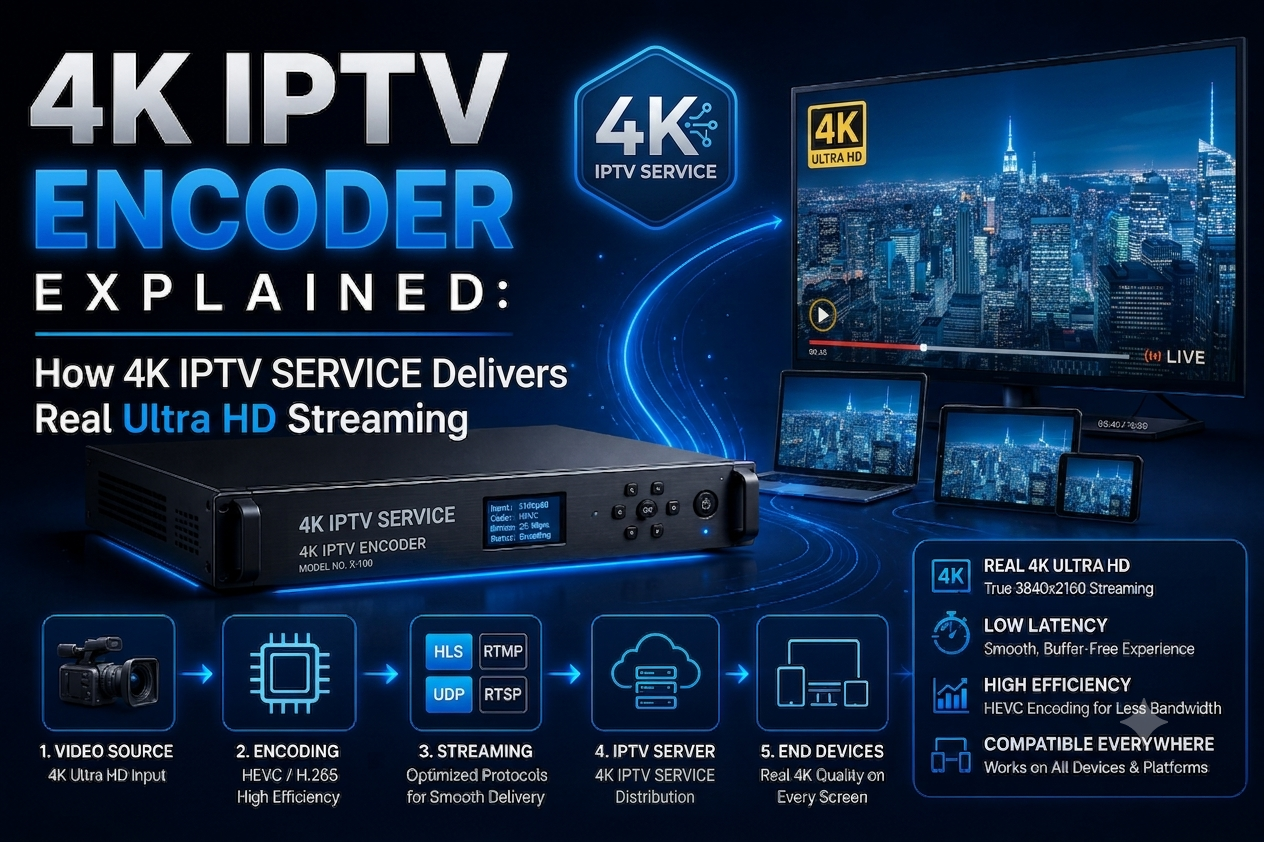
When people search for “4K IPTV encoder”, they are usually looking for two things:
hardware or software that converts 4K video into IPTV streams, and
IPTV providers that actually use this technology to deliver sharp, stable Ultra HD channels.
4K IPTV SERVICE focuses on the second point. Instead of forcing viewers to buy their own encoder, 4K IPTV SERVICE handles all the 4K IPTV encoding on the server side and sends you ready‑to‑watch streams on Firestick, Android TV, Smart TV, iPad, and other devices. You only need a subscription and a good internet connection to enjoy 4K.
What Is a 4K IPTV Encoder?
A 4K IPTV encoder is a device or software that takes a 4K video signal (for example, from a satellite receiver, HDMI input, or camera) and converts it into a compressed IP stream that can be delivered over the internet.
In simple words:
Input: 4K HDMI or SDI video
Processing: compresses video using modern codecs like H.265/HEVC
Output: IP stream that IPTV servers can send to apps and TV boxes
Without a reliable 4K encoder, the stream will either look bad (too much compression) or buffer constantly (bitrate too high for most users).
How a 4K IPTV Encoder Fits Into the 4K IPTV SERVICE Workflow
Behind the scenes, professional IPTV setups use a chain like this:
Source signal – live TV channels, sports feeds, movie channels in 4K.
4K IPTV encoders – convert those raw 4K signals into optimized IP streams using H.265 for lower bandwidth.
IPTV headend / servers – manage, route, and protect the streams.
Content delivery layer – delivers the streams globally with minimal delay.
4K IPTV SERVICE apps and players – your Firestick, Android TV, Smart TV, or mobile app plays the 4K stream.
4K IPTV SERVICE handles all the heavy encoding work for you. You never touch the encoder, but you benefit from it every time you tune into a 4K channel.
Why 4K IPTV Encoders Matter for Viewers
Even if you never see the hardware, the quality of the 4K IPTV encoder affects your daily experience:
Sharper picture – proper 4K encoding keeps fine details in movies, series, and live sports.
Less buffering – H.265/HEVC encoders compress 4K so it fits better into realistic home internet speeds.
Lower latency – tuned encoders reduce delay for live games and events.
Consistent quality – professional encoders are built for 24/7 operation, so channels stay online and stable.
This is why some IPTV services look blurry or freeze during big matches, while others stay smooth. The difference often starts at the encoder.
Key Features of a Good 4K IPTV Encoder
When people talk about “best 4K IPTV encoder”, they usually compare features like:
4K UHD support – real 3840×2160 resolution, not just upscaled 1080p.
Modern codecs – H.265/HEVC (and sometimes AV1 in the future) for efficient compression.
Multiple protocols – support for HLS, RTMP, SRT, UDP and more to fit different IPTV infrastructures.
Low latency modes – important for live sports and interactive content.
24/7 reliability – active cooling, monitoring, redundancy for constant uptime.
4K IPTV SERVICE works with professional‑grade encoders that are designed for continuous Ultra HD broadcasting, not consumer gadgets.
Do 4K IPTV SERVICE Users Need to Buy a 4K IPTV Encoder?
For normal viewers, the answer is no.
You do not need to buy any encoder to watch 4K IPTV SERVICE in 4K. Instead, you need:
A 4K‑capable device (Firestick 4K, Android TV box, 4K Smart TV, etc.)
A stable internet connection with enough bandwidth for 4K streaming
A compatible IPTV player or 4K IPTV SERVICE app
Encoders are mainly for:
Broadcasters who want to send their own content into an IPTV system
Resellers who ingest local channels or custom feeds
Businesses, hotels, or venues that distribute in‑house video over IP
4K IPTV SERVICE takes care of the encoding layer so end‑users get plug‑and‑play access.
How 4K IPTV SERVICE Uses 4K IPTV Encoding to Improve Your Experience
4K IPTV SERVICE is built as a 4K‑ready IPTV service. The goal is to combine the right encoders, codecs, and server infrastructure so you get:
Genuine 4K streams where the source is 4K (not fake upscaled Full HD)
Smart bitrate settings so 4K looks clean but stays watchable on typical home connections
Optimized profiles for popular devices like Firestick, Android TV, and Smart TVs
Stable performance even during peak hours and major sports events
Because the encoding is centralized and controlled by 4K IPTV SERVICE, improvements to quality or latency benefit every user automatically—no need to update hardware at home.
What to Check Before Watching 4K IPTV with 4K IPTV SERVICE
To enjoy the benefits of 4K IPTV SERVICE’s 4K encoders, make sure your setup is ready:
TV / Device: 4K TV or 4K box (Firestick 4K, Nvidia Shield, Android TV, etc.)
Internet speed: ideally 25 Mbps dedicated or higher for smooth 4K, especially if other devices are online
Connection type: wired Ethernet or strong 5 GHz Wi‑Fi for stability
Player app: use a recommended IPTV app that can handle 4K streams without stutter
Once these basics are in place, the difference between 1080p and 4K on 4K IPTV SERVICE is very noticeable—especially in sports, nature, and high‑detail movies.
4K IPTV Encoder vs. 4K IPTV Subscription: What Matters Most?
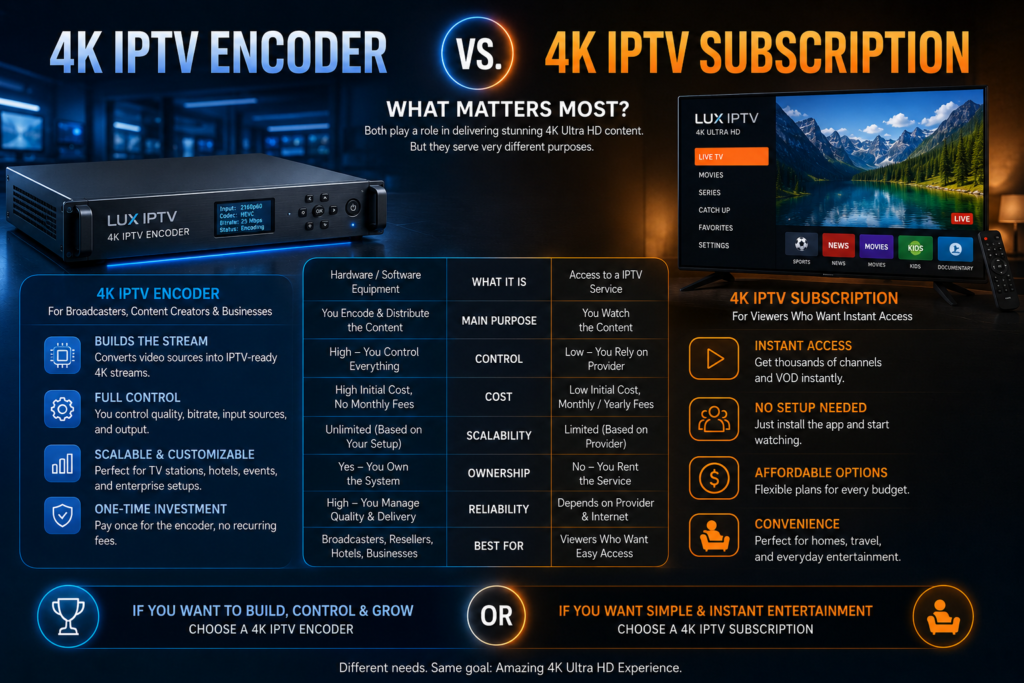
Searching for “4K IPTV encoder” often leads to technical products and long spec sheets, but for most users the real decision is not which encoder to buy, it is which IPTV provider uses good 4K encoders and delivers stable streams.
A great encoder with a bad IPTV platform still results in buffering and downtime.
A strong IPTV provider with professional encoding, smart servers, and support gives you real value, without hardware headaches.
4K IPTV SERVICE focuses on the second solution: it combines professional 4K IPTV encoding, a large channel and VOD catalog, and optimized apps so you can simply subscribe, install, and watch.
Why a True 4K IPTV Service Matters More Than the Hardware
When you invest in a 4K TV, you want more than just a “good enough” HD signal stretched to fill the screen. You want a true 4K IPTV experience: crystal‑clear picture, deep colors, and smooth motion during fast sports or action scenes. That only happens when the entire chain is 4K‑ready—from the original source and 4K IPTV encoder, to the servers, to the app you use at home. If any part of that chain is weak, your 4K TV is just displaying an upscaled HD feed that never looks as sharp as it should.
With 4K IPTV SERVICE, every step is designed around delivering a consistent 4K stream to real users. Professional encoders work with native 4K sources and modern codecs, then optimized servers deliver that 4K IPTV stream to your Firestick, Android TV, Smart TV, tablet, or iPad. For you, that means less buffering, smoother sports, and movies that actually look like 4K—not just marketing. Instead of wasting bandwidth on badly compressed feeds, the platform focuses on clean, efficient 4K streaming that makes your TV and internet connection work together at their best.
The Key Functions of an IPTV 4K Encoder
Compression: Utilizing advanced algorithms to remove redundant visual data without the human eye noticing.
Protocol Translation: Packaging the compressed video into streaming protocols like HLS (HTTP Live Streaming), RTMP (Real-Time Messaging Protocol), or SRT (Secure Reliable Transport) so it can travel across IP networks.
Audio Embedding: Synchronizing high-fidelity audio (like Dolby Digital) perfectly with the video feed.
The Engine of 4K IPTV: The H.265/HEVC Codec
Why H.265 is Mandatory for IPTV 4K
The H.265 standard was designed specifically with 4K and 8K resolutions in mind. It uses incredibly complex mathematical models to predict motion and color across a screen. If a broadcaster is showing a football game, the green grass doesn’t change much from frame to frame; the H.265 codec is smart enough to only transmit the pixels that are actively moving (the players, the ball) rather than redrawing the entire green field 60 times a second.
Bandwidth Efficiency: H.265 offers roughly double the data compression ratio of its predecessor at the exact same level of video quality. This means a flawless 4K IPTV stream can be delivered using half the internet speed that it would have taken previously.
Detail Preservation: HEVC supports wider color gamuts and high dynamic range (HDR), which is what gives IPTV 4K content its signature lifelike pop and deep, cinematic blacks.
Without H.265 hardware encoders working around the clock at the source, commercial 4K IPTV simply would not exist.
How 4K IPTV SERVICE Delivers Real Ultra HD Streaming
Many standard streaming providers claim to offer 4K IPTV, but viewers are often met with “fake 4K”—a standard 1080p feed that has merely been digitally upscaled, resulting in blurry visuals and artifacting during fast motion. Premium providers like 4K IPTV SERVICE stand out because they invest heavily in enterprise-grade encoding infrastructure.
Here is a look behind the curtain at how a premium service ensures you receive actual IPTV 4K to your living room.
1. Enterprise-Grade Hardware Encoders
Delivering over 50,000 channels requires immense processing power. Premium 4K IPTV networks do not rely on standard computers to compress video; they use dedicated hardware encoders. These rack-mounted devices possess specialized microchips (ASICs) built for one sole purpose: encoding H.265 video continuously without overheating or dropping frames. This ensures that the IPTV 4K feed leaves the source in pristine, ultra-high-definition condition.
2. Advanced Anti-Freeze Technology
The biggest enemy of any 4K IPTV viewer is the dreaded buffering wheel. Because 4K data packets are larger than standard definition packets, any hiccup in the network can cause a stream to stall. 4K IPTV SERVICE combats this using proprietary Anti-Freeze Technology at the encoder level. By utilizing advanced adaptive bitrate streaming, the encoder creates multiple profiles of the video. If your internet connection briefly dips, the system instantaneously drops to a slightly lower bitrate to keep the stream alive, before seamlessly bumping you back up to true IPTV 4K once your connection stabilizes.
3. SRT and Low-Latency Protocols
Older IPTV setups relied heavily on protocols that were prone to packet loss, which degrades picture quality. Modern 4K IPTV architectures increasingly use SRT (Secure Reliable Transport). Originally developed by Haivision, SRT is an open-source video transport protocol that optimizes streaming performance across unpredictable internet connections. It forces the encoder to protect against jitter, packet loss, and fluctuating bandwidth, meaning that live sports events in IPTV 4K reach your screen with absolute minimal delay compared to standard cable.
4. Dynamic Auto-Switching Hosts
Even the best 4K encoder is useless if the server it sends data to goes down. Premium 4K IPTV networks route their encoded video through multiple backup servers globally. If one host experiences heavy traffic, the system dynamically auto-switches your connection to the fastest available server with zero downtime, ensuring your IPTV 4K movie night is never interrupted.
The Truth About Your Internet Speed and IPTV 4K
Even with the most powerful H.265 encoders in the world pumping out pristine 4K IPTV streams, the final link in the chain is your home network. To ensure you can unpack and decode the dense HEVC data efficiently, you must meet a few basic requirements:
Sufficient Bandwidth: While H.265 is efficient, a true IPTV 4K stream still requires a stable internet connection. A minimum sustained download speed of 25 to 30 Mbps is recommended. However, for households with multiple devices connected simultaneously, a 100 Mbps connection ensures ample headroom.
A Capable Processor (Your Device): Just as the broadcaster needs a powerful encoder to compress the video, your Smart TV, Android box, or Firestick needs a capable processor to decode it. Older streaming sticks simply do not have the processing power to unpack H.265 4K IPTV streams, resulting in stuttering video or audio desynchronization.
Hardwiring Over Wi-Fi: For the absolute best IPTV 4K experience, it is always recommended to connect your streaming device directly to your router using an Ethernet cable. Wi-Fi signals are subject to interference from walls, microwaves, and neighboring networks, which can disrupt the steady flow of high-density 4K packets.
4K IPTV Encoder Explained: How 4K IPTV SERVICE Delivers Real Ultra HD Streaming
The television landscape has undergone a massive transformation, shifting entirely away from traditional cable and satellite broadcasting toward flexible, internet-based delivery. At the absolute forefront of this entertainment revolution is 4K IPTV. If you have recently upgraded your home theater with a massive Ultra HD screen, you already know that standard definition or heavily compressed 1080p feeds do not cut it anymore. You want true, unadulterated, crystal-clear IPTV 4K quality.
But have you ever wondered how an immense amount of data—millions of pixels flashing 60 times a second—travels from a broadcaster’s server, across the internet, and straight onto your screen without turning into a buffering nightmare? The secret lies in a highly specialized piece of technology: the 4K IPTV encoder.
In this comprehensive guide, we are diving deep into the mechanics of video encoding to explain exactly how it works and how a premium service like 4K IPTV SERVICE—widely recognized as the best USA IPTV service—harnesses this infrastructure to deliver a flawless, high-fidelity viewing experience directly to your home.
What Exactly is a 4K IPTV Encoder?
To understand a 4K IPTV encoder, we first need to look at raw video. A completely uncompressed 4K video feed (3840 x 2160 resolution running at 60 frames per second) requires a staggering amount of bandwidth—upwards of 12 Gigabits per second (Gbps). To put that into perspective, even the fastest consumer fiber-optic internet connections max out at around 1 to 2 Gbps. Streaming raw, uncompressed 4K video over the standard public internet is mathematically and physically impossible.
This is where the digital video encoder steps in.
An encoder is either a robust hardware device or a highly sophisticated piece of server software that acts as a real-time digital translator and compressor. It takes that massive, uncompressed raw video signal—often fed via HDMI or SDI directly from live camera feeds or master control broadcast stations—and mathematically compresses it into a streamlined digital format that can be easily transmitted over standard residential internet connections.
When we talk about premium IPTV 4K, the encoder’s job is exponentially more difficult than standard, low-resolution web streaming. It must compress ultra-high-definition video on the fly, maintaining the brilliant color accuracy, deep contrasts (HDR), and sharp edge details, all while reducing the raw file size by over 99%.
The Core Functions of an IPTV 4K Encoder
Massive Data Compression: Utilizing advanced mathematical algorithms to strip away redundant visual data before the human eye can ever notice a drop in fidelity.
Protocol Packaging: Converting the compressed video blocks into IP-friendly streaming protocols like HLS (HTTP Live Streaming), RTMP (Real-Time Messaging Protocol), or SRT (Secure Reliable Transport) so it can travel safely across web networks.
Audio and Metadata Embedding: Synchronizing high-fidelity multi-channel audio tracks (like Dolby Atmos or Dolby Digital) and electronic program guides (EPG) perfectly alongside the video layers.
The Engine of 4K IPTV: The H.265/HEVC Codec
You cannot talk about 4K IPTV optimization without highlighting its structural lifeblood: the video codec. “Codec” is shorthand for coder-decoder. While older, standard-definition or standard HD streams rely heavily on the legacy H.264 (AVC) standard, true IPTV 4K demands something significantly more powerful. Enter H.265, also universally known as High-Efficiency Video Coding (HEVC).
How 4K IPTV SERVICE Architechture Delivers True Ultra HD Performance
Many standard streaming providers across the web claim to offer 4K IPTV, but viewers are often met with “fake 4K”—which is nothing more than a standard 1080p feed that has merely been digitally upscaled. This results in blurry visuals, digital artifacting during fast-moving sports, and frequent macro-blocking.
As a leading best USA IPTV provider, 4K IPTV SERVICE stands out because our underlying infrastructure invests heavily in true, enterprise-grade encoding and server hardware. Here is an overview of how the technical ecosystem functions behind the scenes:
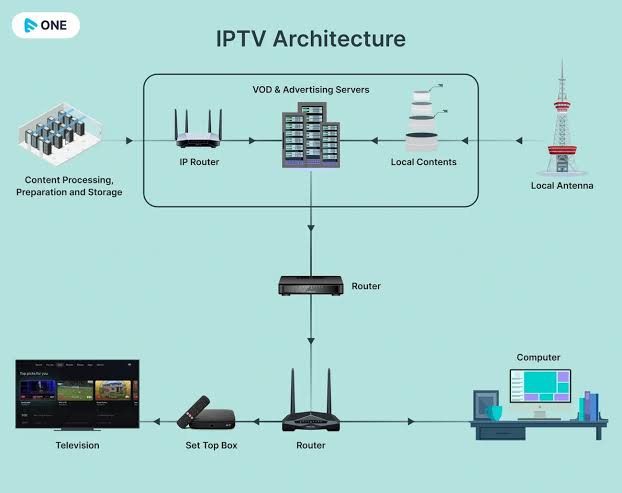
1. Enterprise-Grade Dedicated Hardware Encoders
Delivering a premium catalog of over 25,000+ live channels and a massive library of 150,000+ movies & series requires immense processing power. We do not rely on standard computers to compress video; our network utilizes dedicated hardware encoders. These rack-mounted devices feature specialized microchips (ASICs) built for one sole purpose: encoding H.265 video continuously without dropping a single frame, ensuring that the source feed leaves our data centers in pristine condition.
2. Advanced Anti-Freeze Technology
The single biggest enemy of any IPTV 4K viewer is the dreaded buffering wheel. Because 4K data packets are massive compared to standard definition files, any minor hiccup or jitter along the internet route can cause a stream to stall.
To solve this, 4K IPTV SERVICE integrates proprietary AntiFreeze Technology directly at the server and encoder levels. By utilizing advanced adaptive bitrate streaming, our encoders create multiple high-fidelity profiles of the video simultaneously. If your home internet connection briefly fluctuates, the system instantaneously and invisibly stabilizes the stream to keep your playback perfectly continuous, avoiding the freezing issues common with lesser networks.
3. High-Speed Servers and SRT Protocols
Older, unoptimized IPTV setups relied heavily on protocols that were highly prone to packet loss, which degrades picture quality and causes channel switching lag. Our modern 4K IPTV network architecture utilizes SRT (Secure Reliable Transport) and optimized streaming nodes. SRT actively protects against packet loss and fluctuating bandwidth, meaning that live sports events in IPTV 4K reach your screen with absolute minimal latency and high stability compared to standard digital cable.
Maximizing Your Home Setup for No-Buffering IPTV Performance
Even with the most powerful H.265 encoders in the world pumping out pristine streams across global networks, the final link in the data chain is your home network. To ensure you can unpack and decode the dense HEVC data efficiently, you should optimize a few basic elements of your setup:
| Optimization Factor | Minimum Requirement | Ideal for Ultimate 4K |
| Internet Download Speed | 12 Mbps (Stable) | 25 – 50+ Mbps (For headroom) |
| Connection Type | Wi-Fi (5GHz band) | Hardwired Ethernet Cable |
| Streaming Protocol | Standard M3U URL | Xtream Codes API |
| Playback App | Software Player | IPTV Smarters Pro (Hardware Decoded) |
The Ultimate Entertainment Package: Live Channels, VOD, & Sports
A true, premium IPTV service USA customers can completely rely on shouldn’t just look spectacular—it needs to offer a complete world of content. The beauty of modern server architecture is that it allows providers to host an unprecedented amount of entertainment options all inside a single dashboard.
When you activate a premium subscription with 4K IPTV SERVICE, you aren’t just getting a handful of local feeds. You gain access to a global entertainment hub containing 25,000+ TV Channels and up to 150,000+ Movies & Series in full HD and brilliant 4K quality.
The Role of Bitrate in 4K IPTV Streaming
Bitrate is one of the most important parts of video streaming. It controls how much data is used to display the video every second.
Higher bitrate usually means better image quality, but it also requires stronger internet speed. Lower bitrate uses less data, but the image can become less clear.
A good 4K IPTV encoder helps find the right balance between quality and performance. The goal is to keep the picture sharp while avoiding unnecessary buffering.
For IPTV users, this means a better experience across different internet connections and devices.
With proper bitrate optimization, 4K IPTV SERVICE can help provide:
- Clearer images
- More stable streams
- Reduced buffering
- Better performance on Smart TVs, Android boxes, Firestick, and mobile devices
Why Compression Is Important for Ultra HD IPTV
4K video files are large. Without compression, they would be difficult to stream smoothly. Compression reduces video size while trying to preserve quality.
Modern IPTV encoding uses compression formats that make video delivery more efficient. This allows users to enjoy high-quality content without needing extremely high bandwidth.
Compression helps IPTV services deliver:
- Better streaming speed
- Lower bandwidth usage
- Stable live channels
- Faster playback
- Improved device compatibility
For 4K IPTV SERVICE users, this means Ultra HD content can be delivered more efficiently while still maintaining strong visual quality.
Benefits of 4K IPTV Streaming with 4K IPTV SERVICE
A well-optimized 4K IPTV experience offers several benefits for viewers. Whether you watch live sports, movies, news, documentaries, or entertainment channels, better encoding and streaming quality can improve the entire experience.
1. Sharper Picture Quality
4K resolution provides more detail than standard HD. This makes images look cleaner, sharper, and more realistic, especially on large screens.
2. Better Sports Viewing
Sports require smooth motion and fast response. A good 4K IPTV encoder helps reduce motion blur and improves clarity during fast scenes.
3. More Immersive Movies and Shows
Ultra HD streaming makes movies and series more enjoyable by improving detail, color, and depth.
4. Less Buffering
Optimized encoding helps reduce the amount of data needed for streaming while keeping quality high. This can help reduce buffering and playback interruptions.
5. Multi-Device Support
4K IPTV SERVICE can be used on different devices, including Smart TVs, Android devices, Firestick, tablets, smartphones, and IPTV apps. Good encoding helps streams play more smoothly across different screen sizes and systems.
How to Improve Your 4K IPTV Streaming Quality
Even with advanced IPTV encoding, the user’s setup can affect streaming quality. To get the best results with 4K IPTV SERVICE, follow these simple tips:
- Use a stable high-speed internet connection.
- Connect your device with Ethernet when possible.
- Use a 4K-compatible device.
- Keep your IPTV app updated.
- Restart your router regularly.
- Avoid using too many devices on the same network during streaming.
- Choose a reliable IPTV player that supports high-quality playback.
These steps can help improve channel loading, picture quality, and overall stability.
Conclusion: Ready to Experience Real Ultra HD?
The leap from traditional, highly compressed cable television to true 4K IPTV is a massive technological milestone. It is an achievement made entirely possible by the unsung heroes of modern digital broadcasting: enterprise-grade hardware video encoders, decentralized Content Delivery Networks (CDNs), and highly efficient H.265/HEVC video codecs. They do all the digital heavy lifting—shrinking massive mountains of raw visual data into streamlined, internet-ready packages that float effortlessly straight across the web.
When you choose a top-tier provider like 4K IPTV SERVICE, you are benefiting from a massive, highly optimized streaming network. From the powerful microchips compressing live matches in real-time to our custom anti-freeze protocols routing data packets safely across the globe, every single layer of our service is engineered to deliver a flawless, no buffering IPTV experience directly to your favorite screen.
Why settle for blurry, upscaled channels when you can unlock a universe of true Ultra HD entertainment today? Explore our flexible 1-month, 3-month, 6-month, or popular 1-year plans, and elevate your home viewing experience to a professional standard.